What Width Wedding Band Should You Choose?
Width is the decision people spend the least time on and notice the most. Two millimetres reads as a quiet line on the hand. Eight reads as a statement you feel with every gesture. Here is what each width actually looks like, how it changes the size you need, and how to choose one you will still want in thirty years.
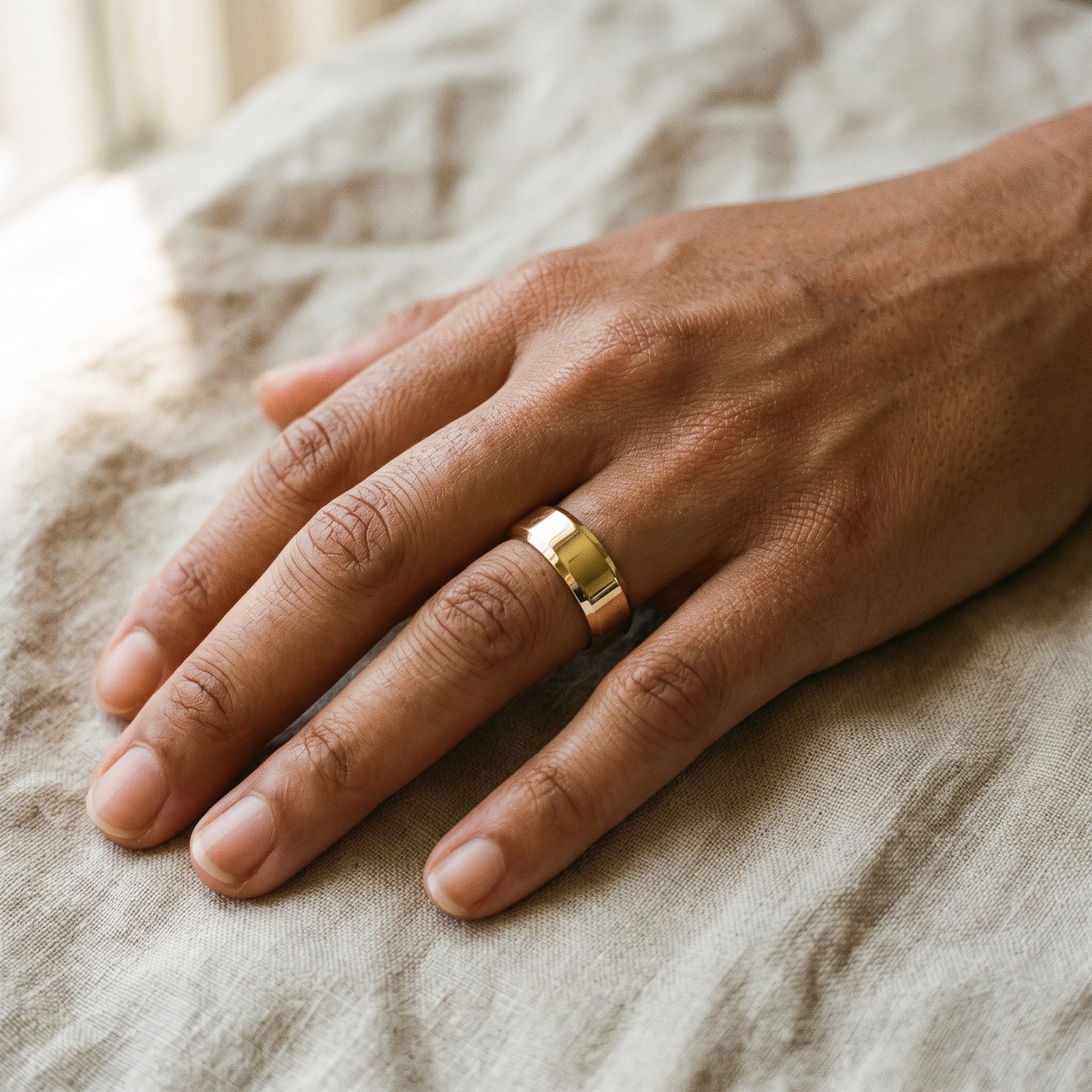
Width in one sentence
Width is how much of your finger the band covers, measured across the band in millimetres. It is not the same as thickness, which is how far the band stands off the finger. A 6 mm band is wide; a 6 mm band that is also thick is heavy. At EON every band is cut at 2 mm thickness, so width alone decides the presence of the ring.
Relative proportion, 2 mm through 12 mm.
Every width, and who it suits
| Width | How it reads | Often chosen by |
|---|---|---|
| 2 mm | A fine gold line. Nearly weightless, disappears into the hand. | Stacking, slim fingers, anyone who forgets they wear a ring |
| 3 mm | Quiet but definitely present. The most forgiving width there is. | The most common women's choice |
| 4 mm | Balanced. Reads as a wedding band from across a table. | Both hands, and the safest first choice |
| 5 mm | Confident without being broad. Shows a finish or texture properly. | The most common men's choice |
| 6 mm | Substantial. You are aware of it, in a good way. | Wider hands, and anyone who wants the ring to be seen |
| 7 to 8 mm | A deliberate statement. Covers a real span of the finger. | Large hands, long fingers, bold taste |
| 9 to 12 mm | Unmistakable. Closer to a cuff than a band. | Collectors, signature wear, very large hands |
EON cuts every band from 2 mm to 12 mm, in half sizes from US 4 to 16. That is more than two hundred and fifty width and size combinations, and none of them are held in stock. Yours is cut after you ask for it.
Width changes the size you need
This is the part most people learn too late. A wider band covers more of your finger, so it grips more skin and passes the knuckle with more resistance. The same nominal size feels tighter as the band gets wider.
- Up to 4 mm: order your true size.
- 5 mm to 7 mm: consider going up a quarter to a half size.
- 8 mm and above: going up a half size is usually right, sometimes a full size.
Comfort fit softens this. Every EON band has a domed inner surface, so it rolls over the knuckle instead of scraping it, which buys back some of the width penalty. Measure with the ring size guide, then adjust for width.
Match the width to the hand, not the trend
Proportion beats fashion here. A 4 mm band on a slender finger reads the same way an 8 mm band reads on a broad one. Two useful checks:
- Finger length. Long fingers carry width easily. Short fingers look longer in something slimmer.
- Knuckle. If your knuckle is much wider than the base of your finger, a narrower band will sit and spin less.
If you work with your hands, width also decides how much of the band meets the world. Wider bands take more marks, and marks in solid gold are not damage. They are a record.
Pairing two bands
Couples usually land in one of three places, and all three are right.
- Matched width. Both bands the same, often 4 mm. The clearest visual pair.
- Stepped. A common pairing is 3 mm and 5 mm, or 4 mm and 6 mm. They read as a set without being identical.
- Matched by profile, not width. Same shape and finish, whatever width each hand wants. Our favourite, because each ring stays comfortable.
What actually ties a pair together is the karat, the color, and the profile, not the millimetres.
Width behaves differently on each profile
The same 6 mm reads narrower on a domed band and wider on a flat one, because a dome curves away from the eye while a flat band shows its whole face.
| Profile | At width | What happens |
|---|---|---|
| Dome | Any | Curves away, so it always reads a touch slimmer than the number |
| Flat | 5 mm and up | Shows its full face, so it reads at its true width or wider |
| Knife-edge | Any | The centre ridge splits the light and slims the band visually |
| Beveled | 5 mm and up | The bevels frame the centre, so width looks intentional rather than heavy |
| Textured | 5 mm and up | Needs width to show the work. Below 5 mm the texture is lost |
If you are drawn to a texture, give it room. The Hammered, Basketweave, Ribbed and Two Tone bands all come alive from 5 mm upward, where the hand can actually read the pattern.
Width questions
What is the most popular wedding band width?
For women, 3 mm to 4 mm. For men, 5 mm to 6 mm. Around 4 mm is the single most chosen width overall because it reads clearly as a wedding band on almost any hand.
Should I size up for a wide wedding band?
Usually yes. Up to 4 mm, order your true size. From 5 mm to 7 mm, consider a quarter to a half size up. At 8 mm and above, a half size up is normally right. Comfort fit, which every EON band has, reduces how much you need to adjust.
Is a 6mm or 8mm wedding band better?
Neither is better; they suit different hands. A 6 mm band is substantial but still easy to live in, and works on most men's hands. An 8 mm band is a deliberate statement and needs a broader hand or longer fingers to look proportional rather than heavy.
Does a wider band mean more gold and a higher price?
Yes. Width is the main driver of how much gold a band contains, so a 8 mm band costs meaningfully more than a 4 mm one in the same karat. Gold is priced at the day's rate when you order.
What width is best for small hands?
2 mm to 4 mm. A slimmer band keeps the proportion of the finger and makes it look longer. If you want presence without width, choose a texture or a two-tone finish instead of extra millimetres.
Do my partner and I need the same width?
No. Matching the karat, the color and the profile ties a pair together far more than matching the millimetres. Stepped pairs such as 3 mm and 5 mm are extremely common and read as a set.
An heirloom is not bought, it is begun.